
Sun, May 8th 2011
The German verb sehen - to see

The German verb sehen – to see

Posted in: German Verb Table, German Verbs

The verb sehen – to see strong verb, formed with haben Below are the verb tables detailing how the German verb sehen is formed depending on the tense of the sentence. Knowing the different forms of sehen through the tenses will allow you to construct sentences much easier. Present Tense Future Tense Conditional Tense ich […]

Read the Full Blog Post

Wed, Apr 27th 2011
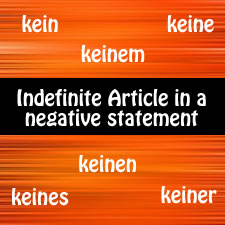
The Indefinite Article in a Negative Statement

The Indefinite Article in a Negative Statement

Posted in: German Grammar

To make a negative statement in English you use the word “not”. In German however it is “kein” and “nicht”. When to use “kein” or “nicht” is explained in our blog Kein or nicht. The ending will change depending on gender and singular or plural form of the following word and depending on the case […]

Read the Full Blog Post


Tue, Apr 26th 2011
The German verb essen - to eat

The German verb essen – to eat

Posted in: German Verb Table, German Verbs

The verb essen – to eat strong verb, formed with haben Below are the verb tables detailing how the German verb essen is formed depending on the tense of the sentence. Knowing the different forms of essen through the tenses will allow you to construct sentences much easier. Present Tense Future Tense Conditional Tense ich […]

Read the Full Blog Post


Wed, Apr 20th 2011
German Vocabulary: All about clothes

German Vocabulary: All about clothes

Posted in: German Vocabulary

In this blog we are looking at German vocabulary related to clothes. Below are 3 tables which split the vocabulary into masculine ‘der’ words, feminine ‘die’ words and neuter ‘das’ words. Masculine words der Anorak anorak der Anzug suit der Ärmel sleeve der Badeanzug swimming costume der Bikini bikini der BH (Büstenhalter) bra der Gürtel […]

Read the Full Blog Post


Thu, Apr 14th 2011
Verbs followed by the Accusative Case

Verbs followed by the Accusative Case

Posted in: German Grammar

Verbs and the Accusative case Everyone knows that the different cases are one of the most difficult parts of the language to get used to. For this reason it’s best to regularly review and practice sentences in each case. The more often you do this, the more confident you will become. In this blog we […]

Read the Full Blog Post


Sat, Apr 9th 2011
The German verb tun - to do

The German verb tun – to do

Posted in: German Verb Table, German Verbs

The verb tun – to do strong verb, formed with haben Below are the verb tables detailing how the German verb tun is formed depending on the tense of the sentence. Knowing the different forms of tun through the tenses will allow you to construct sentences much easier. Present Tense Future Tense Conditional Tense ich […]

Read the Full Blog Post


Wed, Apr 6th 2011
Hamburg - A Guide to Hamburg

Hamburg – A Guide to Hamburg

Posted in: Useful Information Germany

Hamburg is Germany’s second largest city with more than 1.7 million inhabitants. Hamburg has Germany’s biggest port and is as watery as Venice and Amsterdam. Hamburg has two lakes (Binnenalster and Aussenalster) and is traversed by the three rivers Elbe, Alster and Bille. Sights: Rathaus: This baroque town hall with its 647 rooms was built […]

Read the Full Blog Post


Wed, Mar 30th 2011
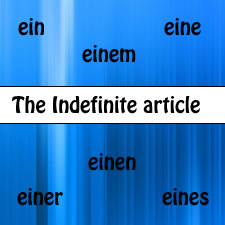
The indefinite Article

The indefinite Article

Posted in: German Grammar

What is an indefinite Article? An indefinite article in English is the word “a”. The word “a” can change into “an” if the following word starts with an vowel. In German, the word “a” is “ein”. The ending will change depending on gender and depending on the case of the sentence. The indefinite article and […]

Read the Full Blog Post


Sun, Mar 27th 2011
The German verb wollen - to want

The German verb wollen – to want

Posted in: German Verb Table, German Verbs

The verb wollen – to want modal verb, formed with haben Below are the verb tables detailing how the German verb wollen is formed depending on the tense of the sentence. Knowing the different forms of wollen through the tenses will allow you to construct sentences much easier. Present Tense Future Tense Conditional Tense ich […]

Read the Full Blog Post

Wed, Mar 23rd 2011
German Vocabulary: North American Countries in German

German Vocabulary: North American Countries in German

Posted in: German Vocabulary

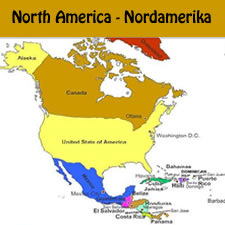
North American Countries In German In this post we are looking at North American countries and the German translations. The list below includes all countries found in North America, Central America and the Caribbean. Some of these countries will by their nature be rarely used in normal conversations, however many will be commonly used. Most […]

Read the Full Blog Post


Wed, Mar 16th 2011
Advanced German Alphabet- Double Vowels and Consonants

Advanced German Alphabet- Double Vowels and Consonants

Posted in: German Vocabulary

Advanced German Alphabet- Double Vowels and Grouped Consonants In this post, we are looking at the advanced features of the German alphabet. We are looking at the pronounciation of words with double vowels and grouped consonants. Below is a table showing the different combinations of vowels and consonants that are important to learn to help […]

Read the Full Blog Post


Sun, Mar 13th 2011
The German verb kommen - to come

The German verb kommen – to come

Posted in: German Verb Table, German Verbs

The verb kommen – to come strong verb, formed with sein Below are the verb tables detailing how the German verb kommen is formed depending on the tense of the sentence. Knowing the different forms of kommen through the tenses will allow you to construct sentences much easier. Present Tense Future Tense Conditional Tense ich […]

Read the Full Blog Post


Wed, Mar 2nd 2011
German Conjunctions - 2 Part Conjunctions

German Conjunctions – 2 Part Conjunctions

Posted in: German Grammar

What are 2 Part German Conjunctions? The German language has conjunctions which have two parts. But don’t worry, it’s not difficult to learn as English has two part conjunctions too 🙂 The most common German two part conjunctions are: sowohl…als auch weder…noch entweder…oder nicht nur…sondern auch The conjunction sowohl…als auch (both…and) Sowohl sein Bruder als […]

Read the Full Blog Post


Sun, Feb 27th 2011
The German verb geben - to give

The German verb geben – to give

Posted in: German Verb Table, German Verbs

The verb geben – to give strong verb, formed with haben Below are the verb tables detailing how the German verb geben is formed depending on the tense of the sentence. Knowing the different forms of geben through the tenses will allow you to construct sentences much easier. Present Tense Future Tense Conditional Tense ich […]

Read the Full Blog Post

Wed, Feb 23rd 2011
German Conjunctions

German Conjunctions

Posted in: German Grammar

What are Conjunctions in German A conjunction is a word which links two sentences. Very common English conjunctions are “and”, “but” and “because”. The most common German conjunctions are aber, als, da, damit, dass, denn, ob, obwohl, oder, sondern, um…zu, und, während, wenn, and weil. Below are some examples of how the most common German […]

Read the Full Blog Post


Wed, Feb 16th 2011
German Vocabulary: All about work

German Vocabulary: All about work

Posted in: German Vocabulary

In this post we are looking at German vocabulary used in and at work. We have split the vocabulary below into masculine, feminine and neuter words. Masculine words der Angestellte employee der Arbeiter worker, labour der Arbeitgeber employer der Arbeitskollege the working colleague der Arbeitslohn wages, pay der Arbeitslose the unemployed man/woman der Arbeitnehmer employee […]

Read the Full Blog Post


Sun, Feb 13th 2011
The German verb nehmen - to take

The German verb nehmen – to take

Posted in: German Verb Table, German Verbs

The verb nehmen – to take strong verb, formed with haben Below are the verb tables detailing how the German verb nehmen is formed depending on the tense of the sentence. Knowing the different forms of nehmen through the tenses will allow you to construct sentences much easier. Present Tense Future Tense Conditional Tense ich […]

Read the Full Blog Post

Wed, Feb 9th 2011
Verbs followed by the Dative Case

Verbs followed by the Dative Case

Posted in: German Grammar, German Verbs, German Vocabulary

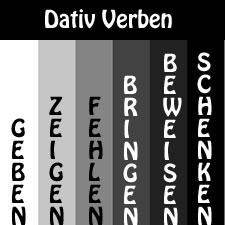
We thought it was time to make a list of the verbs which are followed by the dative case. So here it is: These German verbs are followed by the dative case. You can also read our other blog How the German Cases work – Nominative, Accusative, Dative and Genitive 🙂 German verb English verb […]

Read the Full Blog Post

Wed, Feb 2nd 2011
Frankfurt - A Guide to Frankfurt

Frankfurt – A Guide to Frankfurt

Posted in: Useful Information Germany

Frankfurt is the only skyscraper city in Germany with about 660000 inhabitants. The urban area alone has 5 million inhabitants. Frankfurt is the financial heart of Germany, indeed, it is the financial heart of Europe with the European Central Bank. Frankfurt’s stock market is one of the world’s largest stock exchange. Besides the financial side, […]

Read the Full Blog Post


Sun, Jan 30th 2011
The German verb schreiben - to write

The German verb schreiben – to write

Posted in: German Verb Table, German Verbs

The verb schreiben – to write strong verb, formed with haben Below are the verb tables detailing how the German verb schreiben is formed depending on the tense of the sentence. Knowing the different forms of schreiben through the tenses will allow you to construct sentences much easier. Present Tense Future Tense Conditional Tense ich […]

Read the Full Blog Post