The German verb liegen - to lie

The German verb liegen – to lie

The verb liegen – to lie strong verb, formed with haben Below are the verb tables detailing how the German verb liegen is formed depending on the tense of the sentence. Knowing the different forms of liegen through the tenses will allow you to construct sentences much easier. Present Tense Future Tense Conditional Tense ich […]

Read the Full Blog Post

Sun, Jul 3rd 2011 |
No Comments
German Indefinite Pronouns Part 2

German Indefinite Pronouns Part 2

What is an indefinite pronoun? An indefinite pronoun is a type of pronoun that is used to refer to unknown or unspecified objects, beings or places. In the first part we were looking at the words alle = all, beide = both, diese = this and einige = few. In this part we are looking […]

Read the Full Blog Post

Wed, Jun 29th 2011 |
2 Comments
General Information about Germany

General Information about Germany

Population: Germany has nearly 82 million inhabitants and is the most populated country in the European Union. It has 16 counties. Every county has their own parties with a party leader. Germany has 9 neighbouring countries. These are Denmark, Poland, Czech Republic, Austria, Switzerland, France, Luxembourg, the Netherlands and Belgium. Weather: Germany can get chilly […]

Read the Full Blog Post

Wed, Jun 22nd 2011 |
3 Comments
The German verb arbeiten - to work

The German verb arbeiten – to work

The verb arbeiten – to work weak verb, formed with haben Below are the verb tables detailing how the German verb arbeiten is formed depending on the tense of the sentence. Knowing the different forms of arbeiten through the tenses will allow you to construct sentences much easier. Present Tense Future Tense Conditional Tense ich […]

Read the Full Blog Post

Sun, Jun 19th 2011 |
No Comments
German Vocabulary: All about Careers

German Vocabulary: All about Careers

In this post we are looking at German vocabulary around the subject of careers. Below are common career titles that are listed in both masculine (der) format for men and feminine (die) format for women. Masculine/Feminine words der Apotheker / die Apothekerin chemist der Architekt / die Architektin architect der Arzt / die Ärztin doctor […]

Read the Full Blog Post

Wed, Jun 15th 2011 |
5 Comments
German Indefinite Pronouns

German Indefinite Pronouns

What is an indefinite pronoun? An indefinite pronoun is a type of pronoun that is used to refer to unknown or unspecified objects, beings or places. In this first part we are looking at the words alle = all, beide = both, diese = this and einige = few       Indefinite Pronoun Table […]

Read the Full Blog Post

Wed, Jun 8th 2011 |
7 Comments
The German verb schlafen - to sleep

The German verb schlafen – to sleep

The verb schlafen – to sleep strong verb, formed with haben Below are the verb tables detailing how the German verb schlafen is formed depending on the tense of the sentence. Knowing the different forms of schlafen through the tenses will allow you to construct sentences much easier. Present Tense Future Tense Conditional Tense ich […]

Read the Full Blog Post

Sun, Jun 5th 2011 |
No Comments
German Possessive Adjectives

German Possessive Adjectives

Possessive Adjectives In this blog we will explain possessive adjectives like my, your, her, his etc. These words are used in combination with a noun to show that something or someone belongs to someone. Depending on the case and if used in singular or plural the possessive adjective will change its ending.       […]

Read the Full Blog Post

Wed, Jun 1st 2011 |
4 Comments
Köln - A Guide to Cologne (Köln)

Köln – A Guide to Cologne (Köln)

Germany’s fourth-largest city with nearly a million inhabitants is located on both sides of the Rhine River. Cologne is a very interesting city with diverse architecture, plenty of museums and is home to numerous TV and radio stations. That’s why it is well known as Germany’s media capital. Cologne is also considered as the gay […]

Read the Full Blog Post

Wed, May 25th 2011 |
1 Comment
The German verb müssen - to have to

The German verb müssen – to have to

The verb müssen – to have to modal verb, formed with haben Below are the verb tables detailing how the German verb müssen is formed depending on the tense of the sentence. Knowing the different forms of müssen through the tenses will allow you to construct sentences much easier. Present Tense Future Tense Conditional Tense […]

Read the Full Blog Post

Sun, May 22nd 2011 |
2 Comments
German Vocabulary: Oceania Countries in German

German Vocabulary: Oceania Countries in German

Oceania Countries In German In this post we are looking at Oceania countries and the German translations. The list below includes all countries found in Oceania. Some of these countries will by their nature be rarely used in normal conversations, however many will be commonly used. Most of the Oceania countries in German are neuter, […]

Read the Full Blog Post

Wed, May 18th 2011 |
No Comments
Inseparable and Separable Verbs with Video

Inseparable and Separable Verbs with Video

What is a Separable and Inseparable Verb in German? A separable verb in German is a verb with a German prefix. A prefix is an additional word such as an (on, to, by) or ein (on) which is added to the beginning of a verb to change its meaning. For example: anschauen, einkaufen, umziehen An […]

Read the Full Blog Post

Wed, May 11th 2011 |
4 Comments
The German verb sehen - to see

The German verb sehen – to see

The verb sehen – to see strong verb, formed with haben Below are the verb tables detailing how the German verb sehen is formed depending on the tense of the sentence. Knowing the different forms of sehen through the tenses will allow you to construct sentences much easier. Present Tense Future Tense Conditional Tense ich […]

Read the Full Blog Post

Sun, May 8th 2011 |
1 Comment
The Indefinite Article in a Negative Statement

The Indefinite Article in a Negative Statement

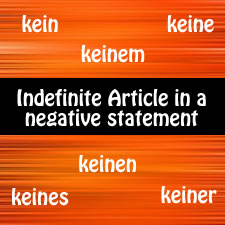
To make a negative statement in English you use the word “not”. In German however it is “kein” and “nicht”. When to use “kein” or “nicht” is explained in our blog Kein or nicht. The ending will change depending on gender and singular or plural form of the following word and depending on the case […]

Read the Full Blog Post

Wed, Apr 27th 2011 |
1 Comment
The German verb essen - to eat

The German verb essen – to eat

The verb essen – to eat strong verb, formed with haben Below are the verb tables detailing how the German verb essen is formed depending on the tense of the sentence. Knowing the different forms of essen through the tenses will allow you to construct sentences much easier. Present Tense Future Tense Conditional Tense ich […]

Read the Full Blog Post

Tue, Apr 26th 2011 |
No Comments
German Vocabulary: All about clothes

German Vocabulary: All about clothes

In this blog we are looking at German vocabulary related to clothes. Below are 3 tables which split the vocabulary into masculine ‘der’ words, feminine ‘die’ words and neuter ‘das’ words. Masculine words der Anorak anorak der Anzug suit der Ärmel sleeve der Badeanzug swimming costume der Bikini bikini der BH (Büstenhalter) bra der Gürtel […]

Read the Full Blog Post

Wed, Apr 20th 2011 |
No Comments
Verbs followed by the Accusative Case

Verbs followed by the Accusative Case

Verbs and the Accusative case Everyone knows that the different cases are one of the most difficult parts of the language to get used to. For this reason it’s best to regularly review and practice sentences in each case. The more often you do this, the more confident you will become. In this blog we […]

Read the Full Blog Post

Thu, Apr 14th 2011 |
3 Comments
The German verb tun - to do

The German verb tun – to do

The verb tun – to do strong verb, formed with haben Below are the verb tables detailing how the German verb tun is formed depending on the tense of the sentence. Knowing the different forms of tun through the tenses will allow you to construct sentences much easier. Present Tense Future Tense Conditional Tense ich […]

Read the Full Blog Post

Sat, Apr 9th 2011 |
No Comments
Hamburg - A Guide to Hamburg

Hamburg – A Guide to Hamburg

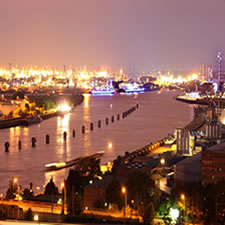
Hamburg is Germany’s second largest city with more than 1.7 million inhabitants. Hamburg has Germany’s biggest port and is as watery as Venice and Amsterdam. Hamburg has two lakes (Binnenalster and Aussenalster) and is traversed by the three rivers Elbe, Alster and Bille. Sights: Rathaus: This baroque town hall with its 647 rooms was built […]

Read the Full Blog Post

Wed, Apr 6th 2011 |
No Comments
The indefinite Article

The indefinite Article

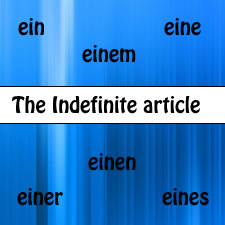
What is an indefinite Article? An indefinite article in English is the word “a”. The word “a” can change into “an” if the following word starts with an vowel. In German, the word “a” is “ein”. The ending will change depending on gender and depending on the case of the sentence. The indefinite article and […]

Read the Full Blog Post

Wed, Mar 30th 2011 |
4 Comments