
 What is a Command in German – Imperative?
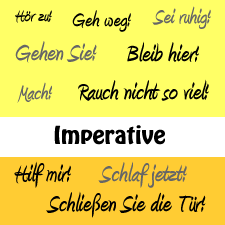
An Imperative is used when giving commands, orders or instructions like “Shut up!” or “Help me!” In these cases the verb will be formed in a special way.
The three different forms of the German imperative:
There are three ways of giving commands in German by using the German imperative. When to use which form depends on who you are talking to. It could be either:
– the informal “du” form if you are talking to a person which you know well
– the informal “ihr” form if you are talking to more than one person which you know well
– the formal “Sie” form if you are talking to one or more than one person which you don’t know very well
If you’re not sure, when to use du, ihr or Sie read our blog When to use Sie, du and ihr
Forming the German imperative:
| Form of Imperative | Verb Example | Translation | |
| du (singular) | verb stem (+e) | mach(e)! | make! |
| ihr (plural) | verb stem + t | macht! | make! |
| Sie (polite singular and plural) | verb stem + en | machen Sie! | make! |
As you can see from the table above, the pronouns du and ihr are dropped, leaving only the verb itself when using the imperative in German. The only time when the pronoun still appears is when using the Sie form.
Some more examples:
fang(e)! – catch
fangt! – catch
fangen Sie! – catch
komm(e)! – come
kommt – come
kommen Sie! – come
With the du form, the last -e of the verb is usually dropped. There are of course exceptions, but these are very rare. For example, when the stem of the verb ends in chn- or fn- or tm- the -e is kept to make the pronunciation easier.
Remember that sometimes the du form of a verb can have a vowel change. In these cases, the imperative in German will also have a vowel change.
For example:
lesen (to read): du liest – lies!
essen (to eat): du isst – iss!
BUT if there is a vowel change which involves an umlaut, this umlaut is not added to the du form in the imperative.
For example:
schlafen (to sleep): du schläfst – schlaf!
fahren (to drive): du fährst – fahr!
The German imperative is important to get to grips with. Being able to give commands in German is a key step in learning the German language.